
Key points
What the study shows
Adsorption of Sb onto ferrihydrite and schwertmannite
produces measurable equilibrium isotope fractionation.
The lighter 121Sb isotope is preferentially
retained on the mineral surfaces, leaving the dissolved
Sb relatively enriched in 123Sb.
Fractionation is similar for Sb(III) and Sb(V) and for
both Fe mineral phases under the experimental
conditions.
Neither pH nor the initial Fe:Sb ratio produced a
significant change in the measured isotope
fractionation factors.
Summary
Understanding how adsorption modifies Sb isotope signatures
Adsorption onto secondary Fe minerals is one of the main processes controlling the mobility of antimony in acid mine drainage and mine-impacted streams. Ferrihydrite and schwertmannite can efficiently retain dissolved Sb as acidic drainage waters evolve downstream.
For Sb isotopes to be used as tracers of environmental transport, it is therefore necessary to determine whether this retention process changes the isotope composition of the dissolved and adsorbed pools.
This study experimentally investigated the equilibrium isotope fractionation produced during adsorption of both Sb(III) and Sb(V) onto ferrihydrite and schwertmannite. Experiments were carried out under controlled pH and solid-to-liquid conditions, allowing the effect of mineral phase, Sb oxidation state and Fe:Sb ratio to be compared.
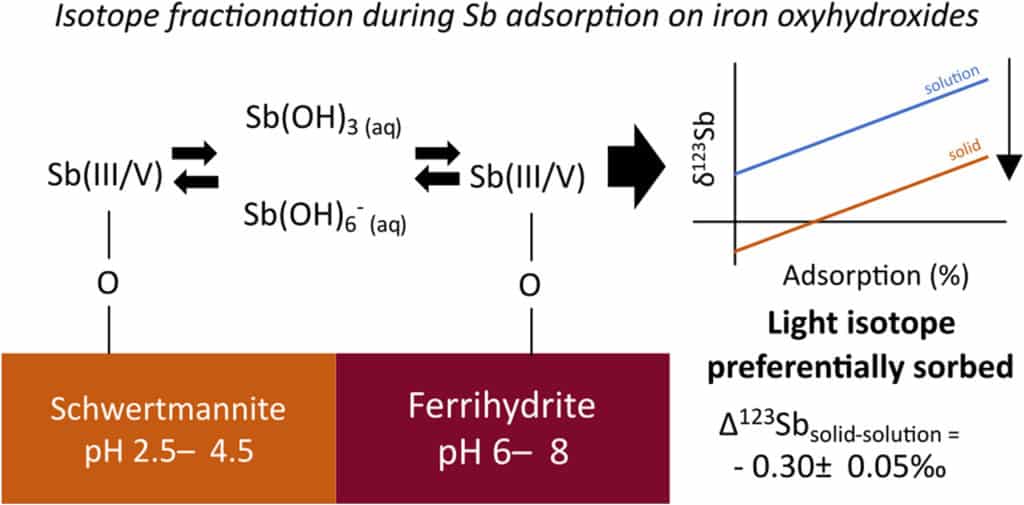
All experimental systems showed preferential retention of the lighter 121Sb isotope on the solid phase. Consequently, dissolved Sb becomes relatively enriched in the heavier 123Sb isotope as adsorption proceeds.
The similar isotope response observed for both Sb oxidation states and both Fe minerals indicates a relatively consistent equilibrium fractionation associated with this adsorption process under the investigated conditions.
Main result
Adsorption onto ferrihydrite and schwertmannite preferentially removes the lighter 121Sb isotope from solution. The resulting Δ123Sbsolid–solution values range from approximately −0.25 to −0.36‰. The direction and magnitude of the fractionation are broadly similar for Sb(III) and Sb(V), and no significant effect of pH or initial Fe:Sb ratio was detected under the experimental conditions.
Experimental results
Similar isotope fractionation across both minerals and oxidation states
The four experimental systems produce negative Δ123Sbsolid–solution values, confirming preferential adsorption of the lighter Sb isotope onto the Fe-bearing solid phase.
Experimental evidence
The isotope response is linked to the adsorption process
The negative Δ123Sbsolid–solution values consistently indicate enrichment of 121Sb on the adsorbing mineral phase. The similarity between experiments suggests that this fractionation reflects a common change in the local bonding environment of Sb when it moves from the aqueous phase to an Fe-bearing surface.
The solid phase is isotopically lighter than the remaining dissolved Sb because 121Sb is preferentially adsorbed.
Ferrihydrite and schwertmannite generate comparable fractionation factors despite their different mineral structures.
Within the tested experimental range, pH and the initial Fe:Sb ratio do not significantly alter the equilibrium isotope fractionation.
Environmental significance
Why this matters for isotope tracing in mine waters
Sb isotope signatures measured downstream from mining areas do not reflect only the initial source of antimony, but also the processes affecting it after release. Understanding the fractionation induced by adsorption therefore helps distinguish changes produced during environmental transport from differences directly inherited from the contamination source.
Publication
Scientific reference
Citation
Ferrari, C., Resongles, E., Freydier, R., Casiot, C. (2024). Antimony isotope fractionation during Sb(V) and Sb(III) adsorption on secondary Fe-minerals (schwertmannite, ferrihydrite) typical of mine waters. Applied Geochemistry, 163, 105935.
DOI:
10.1016/j.apgeochem.2024.105935
Read the paper