
Key points
What the study shows
Oxidation of Sb(III) to Sb(V) can produce measurable
isotope fractionation, meaning that redox processes
can modify environmental Sb isotope signatures.
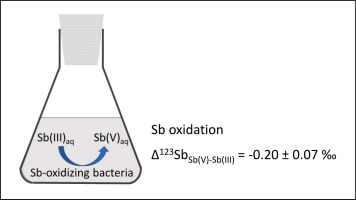
Biotic oxidation mediated by
Ensifer produces a negative
Δ123SbSb(V)−Sb(III),
with the newly oxidized Sb(V) relatively enriched
in the lighter isotope.
Abiotic oxidation with H₂O₂ in an HCl medium
produces the opposite response, enriching the
oxidized Sb(V) pool in the heavier
123Sb isotope.
The contrasting direction of isotope fractionation
suggests that Sb isotopes may help distinguish
different oxidation pathways in environmental
systems.
Summary
Oxidation pathways leave different isotope fingerprints
The environmental mobility and toxicity of antimony are strongly influenced by its oxidation state. Sb commonly occurs as Sb(III) and Sb(V), and transformations between these species can occur through both abiotic chemical reactions and biologically mediated processes.
For Sb isotopes to be used effectively as environmental tracers, it is therefore necessary to understand whether oxidation itself changes isotope composition and whether different oxidation pathways produce distinguishable isotope effects.
This study experimentally investigates isotope fractionation during the oxidation of Sb(III) to Sb(V) using both biotic and abiotic systems. The experiments include Sb-oxidizing bacteria as well as oxidation by hydrogen peroxide under different chemical conditions.
The results show that oxidation can generate significant isotope fractionation, but the direction of the effect depends on the oxidation mechanism. Biotic oxidation produces a lighter Sb(V) isotope signature relative to Sb(III), whereas oxidation by H₂O₂ in HCl produces heavier Sb(V).
These contrasting behaviours demonstrate that δ123Sb variations in natural waters may record not only differences in source material but also the redox transformations affecting Sb after its release into the environment.
Main result
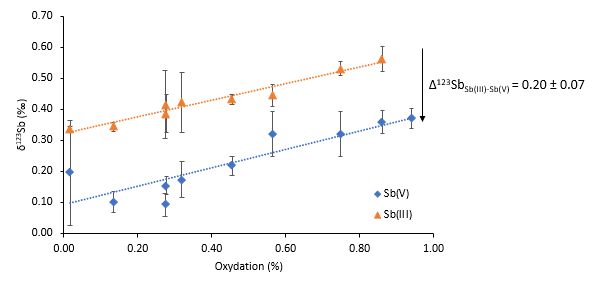
Biotic and abiotic oxidation can generate isotope fractionation in opposite directions. Oxidation mediated by Ensifer produces a Δ123SbSb(V)−Sb(III) of approximately −0.20‰, whereas abiotic oxidation with H₂O₂ in HCl enriches Sb(V) in the heavier isotope, with ε123Sb of approximately +0.30‰. This contrast provides a potential isotope signature for distinguishing oxidation mechanisms.
Experimental results
Two oxidation pathways, two contrasting isotope signatures
The clearest contrast observed in the experiments is between biologically mediated oxidation and abiotic oxidation by hydrogen peroxide under acidic chloride conditions.
Experimental evidence
The oxidation mechanism controls the direction of isotope fractionation
The evolution of Sb isotope composition during the experiments demonstrates that isotope fractionation is not a universal consequence of oxidation with a single direction or magnitude. Instead, the resulting isotope signature depends on the reaction pathway and the chemical or biological mechanism responsible for converting Sb(III) to Sb(V).
Environmental significance
Why this matters for interpreting Sb isotope signatures in natural systems
Sb isotope compositions measured in mine waters, sediments or contaminated environments may evolve after Sb has been released from its original source. Oxidation of Sb(III) to Sb(V) is one process capable of modifying that signature, and this study shows that the direction of isotope fractionation depends on whether oxidation is biologically or abiotically mediated. Accounting for these redox effects is therefore essential when isotope signatures are used to distinguish contamination sources from environmental transformation processes.
Publication
Scientific reference
Citation
Ferrari, C., Resongles, E., Héry, M., Désoeuvre, A., Freydier, R., Delpoux, S., Bruneel, O., Casiot, C. (2023). Antimony isotopic fractionation during Sb(III) oxidation to Sb(V): Biotic and abiotic processes. Chemical Geology, 641, 121788.
DOI:
10.1016/j.chemgeo.2023.121788
Read the paper