

Key points
What the study shows
Soils at the site locally show strong Pb contamination
and more moderate Sb contamination.
Anthropogenic soil contamination is mainly concentrated
in the surface horizons.
Sb isotopes help distinguish contributions related to
ore-bearing material from those associated with
metallurgical residues.
Combining Pb and Sb isotope systems improves source
identification in an environment where several
geochemical signatures overlap.
Summary
Distinguishing multiple sources of contamination
At historical mining and metallurgical sites, waste rock, ore-bearing materials and metallurgical residues can coexist with naturally mineralized bedrock. This makes it difficult to determine the origin of metals measured in soils and sediments.
This study evaluates the benefit of combining Pb and Sb isotope systems at the Peisey-Nancroix site in the French Alps. Rather than relying on a single tracer, the approach uses the complementary information carried by both isotope systems.
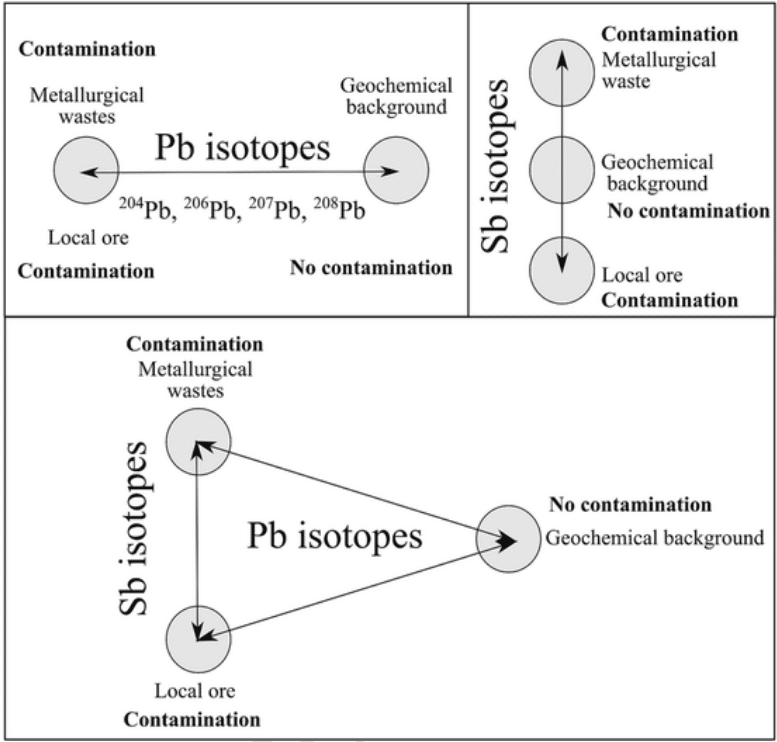
Pb isotope signatures provide information on the presence and extent of anthropogenic contamination, while Sb isotope compositions differ between ore-bearing rocks and some metallurgical wastes.
This contrast reflects Sb isotope fractionation during metallurgical processing. As a result, the combined Pb–Sb approach provides more information on contaminant origin than either isotope system used alone.
Main result
Pb provides information on the presence and magnitude of anthropogenic contamination, while Sb adds complementary information on the nature of the source. In particular, Sb isotope signatures help distinguish contributions associated with ore-bearing material from those linked to metallurgical waste.
Field application
A multi-isotope approach applied to a historical mining and metallurgical site
Combining Pb and Sb provides two complementary lines of evidence for interpreting contamination at the Peisey-Nancroix site. The approach helps separate naturally mineralized materials from anthropogenic residues and improves the discrimination of overlapping contamination sources.
Publication
Scientific reference
Citation
Guillevic, F., Rossi, M., Resongles, E., Freydier, R., Ferrari, C., Quantin, C., Monvoisin, G., Poulenard, J., Arnaud, F. (2024). Multi-isotope (Pb, Sb) approach to trace metallic contaminant sources at a historical mining and metallurgical site. Chemical Geology, 649, 121958.
DOI:
10.1016/j.chemgeo.2024.121958
Read the paper