As- and Sb-bearing minerals frequently coexist. Distinct Sb isotope signatures can therefore help discriminate among different ores, wastes and mining-related source materials.

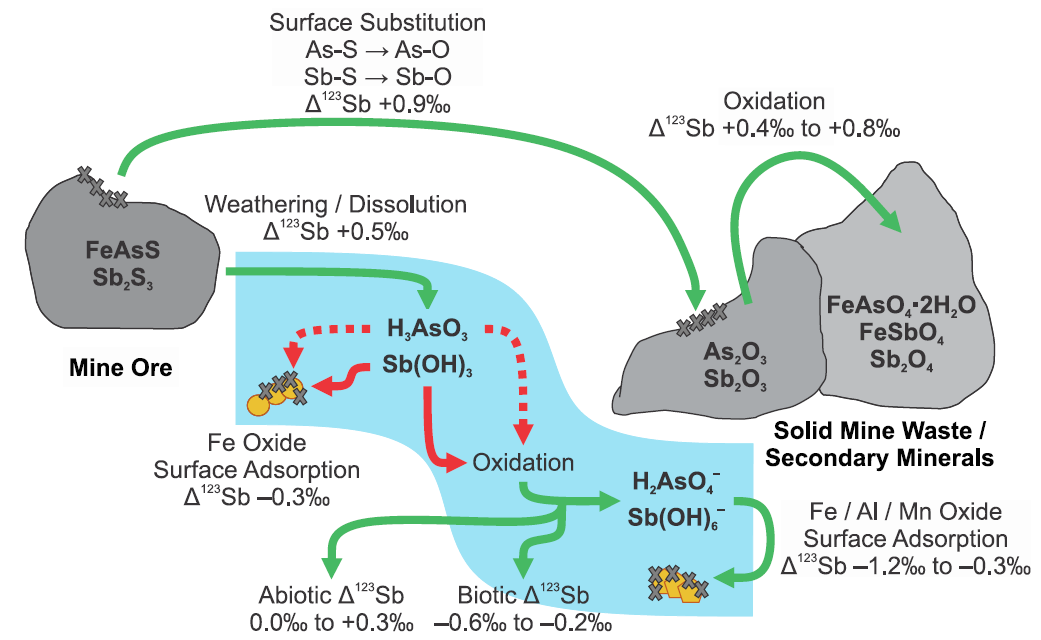
Arsenic contamination is a recurring problem in mining-impacted environments. Concentration measurements can quantify contamination but generally provide limited information about its origin, while arsenic speciation can help characterize geochemical conditions without necessarily identifying the processes responsible for contaminant transport.
Unlike many metal contaminants, As has only one stable isotope and therefore lacks the natural isotopic variability required for direct stable-isotope tracing. Antimony provides an especially interesting alternative: As and Sb belong to the same group of the periodic table, occur in comparable oxidation states and frequently coexist in ores, mine wastes and contaminated waters.
Sb has two relatively abundant stable isotopes: 121Sb, representing approximately 57% of naturally occurring Sb, and 123Sb, representing approximately 43%. Analytical advances have enabled a rapidly growing number of studies of Sb isotope fractionation in minerals, water, soil and sediments.
This review synthesizes current knowledge of the major processes affecting both As and Sb, including ore formation, weathering and dissolution, redox transformations, adsorption onto mineral surfaces and volatilization. It then evaluates under which conditions Sb isotope variations can provide useful information about arsenic sources and mobility.
Sb isotopes are a promising proxy for tracing As sources and selected processes such as weathering and leaching. Their ability to accurately represent arsenic behaviour becomes less reliable when the two elements respond differently, particularly during redox transformations and adsorption. Interpretation must therefore remain specific to the site and process being studied.
The review shows that the usefulness of the Sb–As proxy varies strongly with the geochemical process involved. Some processes affect both elements in sufficiently similar ways to support a shared interpretation, whereas others produce substantial differences in behaviour.
As- and Sb-bearing minerals frequently coexist. Distinct Sb isotope signatures can therefore help discriminate among different ores, wastes and mining-related source materials.
Drainage waters are often enriched in 123Sb relative to their solid sources. Aqueous–solid fractionations of approximately +0.5‰ have been observed in some systems.
Biotic and abiotic Sb oxidation can produce isotope fractionation in opposite directions. This contrast may provide useful process information, but requires identification of the dominant oxidation pathway.
As(V) and Sb(V) often display comparable behaviour under oxidizing conditions. Under reducing conditions, however, Sb(III) is generally retained much more strongly than As(III), limiting the use of Sb as a universal proxy.
The conceptual framework summarizes the main processes controlling the fate of As and Sb in mining-impacted environments and the associated Sb isotope fractionations. It distinguishes situations in which the two elements behave similarly from those in which their geochemistry diverges and Sb becomes a less reliable proxy for arsenic.
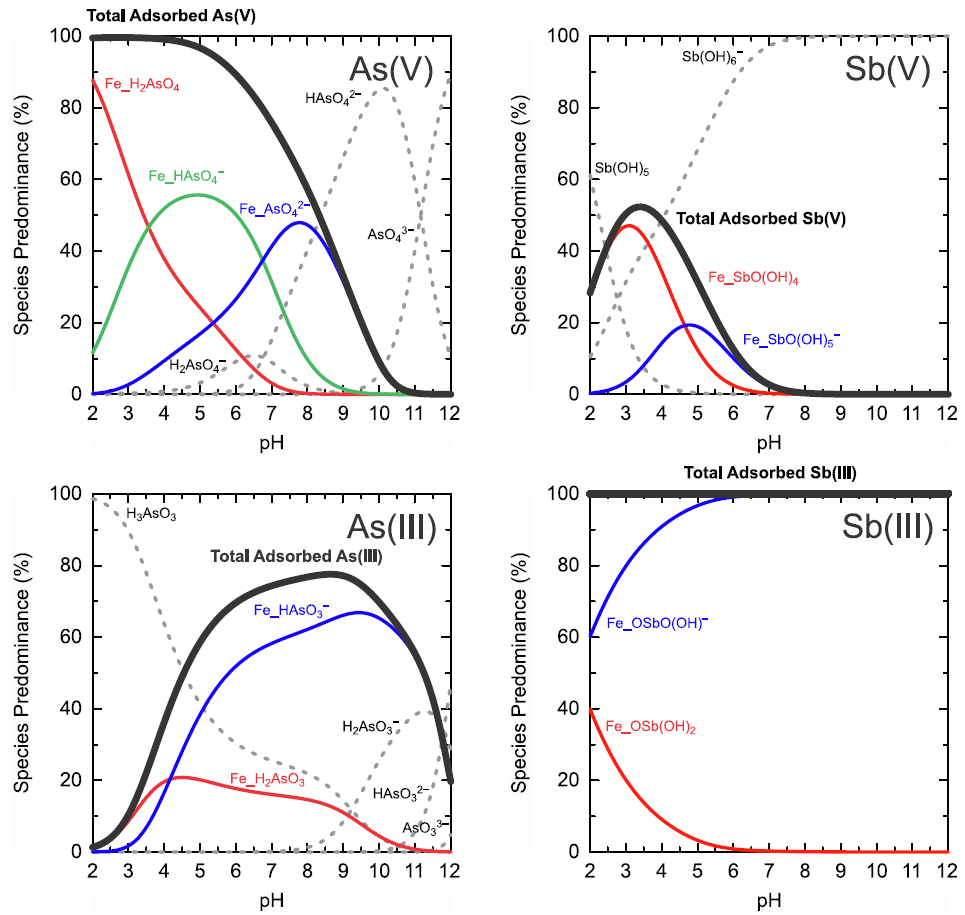
At mining sites where several ores, waste deposits, drainage waters and atmospheric emissions contribute simultaneously to contamination, arsenic concentrations alone cannot distinguish sources or reconstruct the processes responsible for transport. Sb isotope compositions provide an independent line of evidence that can complement concentration measurements, speciation and mineralogical information. Their value is particularly strong where As and Sb share a common source or geochemical process. The review nevertheless emphasizes that Sb isotopes should not be applied as a universal As proxy: effective interpretation requires representative characterization of source materials, environmental matrices and site-specific geochemical conditions.
Ferrari, C., White, K.B., Ptacek, C.J., Blowes, D.W. (2026). Tracing arsenic and antimony in mining-impacted environments: New insights from antimony isotopes. Chemical Geology, 707, 123271.
IsotopiX combines isotope fingerprints and geochemical evidence to distinguish sources, identify the processes controlling contaminant transport and provide independent analytical evidence in complex mining environments.
Discuss a project