
Key points
What the study shows
Sb isotopes distinguish two different anthropogenic
influences: acid mine drainage from San José and
inputs associated with smelting activities in Vinto.
Along Canal Rosso, dissolved δ123Sb
progressively increases while Sb concentration
decreases and secondary Fe-rich phases form.
Sb retained in suspended particles and sediments is
relatively enriched in the lighter isotope, with an
average
Δ123Sbwater–sediment
of approximately +0.3‰.
Seasonal changes in the Sb isotope composition of
Lake Uru-Uru are consistent with variable
contributions from rivers affected by mining and
smelting activities.
Summary
Distinguishing sources and transport processes in a complex mining system
Antimony is an emerging contaminant commonly associated with mining and metallurgical environments. Concentration measurements can quantify contamination, but they do not always make it possible to distinguish different sources or identify the processes controlling Sb transport.
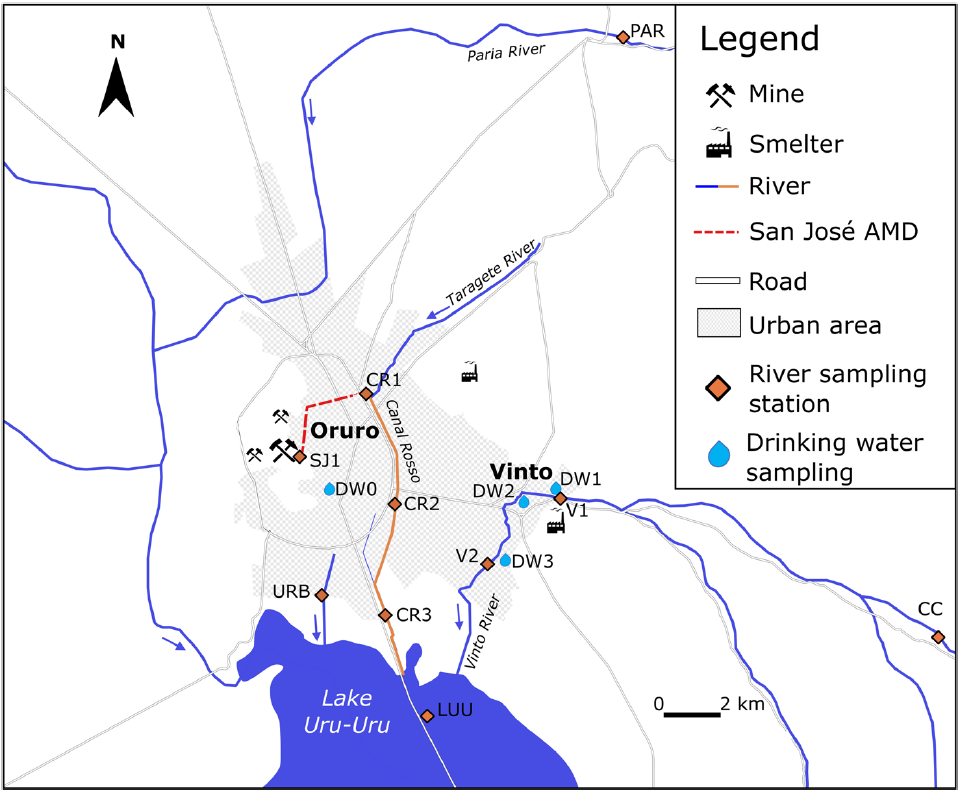
This study evaluates the potential of stable Sb isotopes as environmental tracers in the Oruro region of the Bolivian Altiplano. Two hydrological systems were investigated: the continuum originating from acid mine drainage at the San José mine and flowing through Canal Rosso toward Lake Uru-Uru, and the Vinto River, which is affected by metallurgical activities.
Sb concentration, redox speciation and isotope composition were measured in water, suspended particulate matter and sediments during two contrasting campaigns: at the end of the wet season in 2019 and at the end of the dry season in 2021.
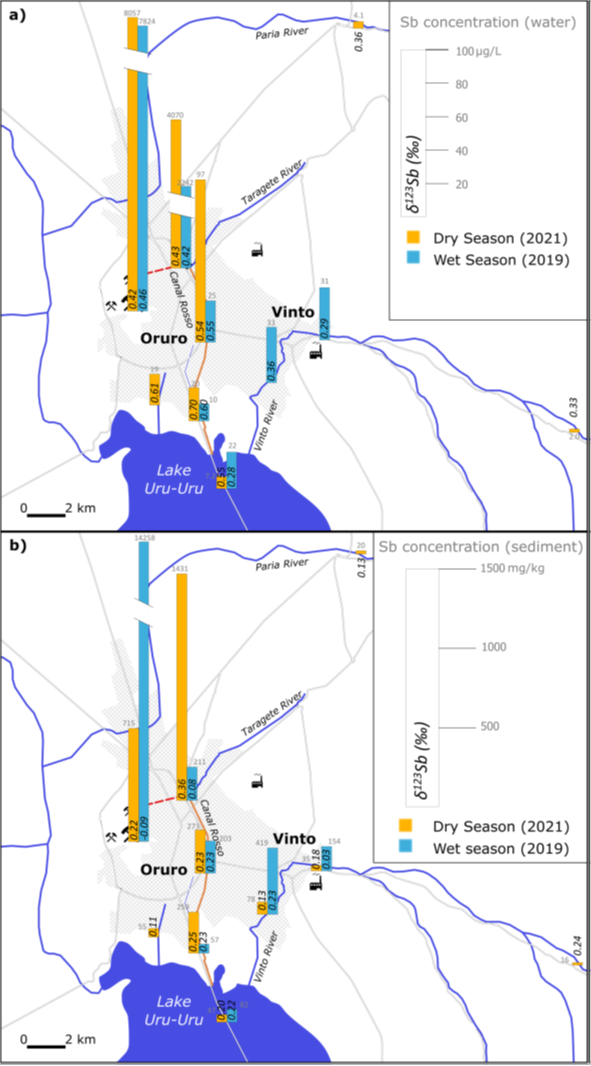
The system spans a pronounced geochemical gradient, from highly acidic mine drainage with a pH close to 1.6 and up to approximately 8 mg·L−1 of dissolved Sb, to much less contaminated and near-neutral waters downstream. Across all samples, δ123Sb values range from −0.09 to +0.93‰.
Along the San José–Canal Rosso continuum, dissolved Sb concentrations decrease strongly while δ123Sb in the water increases. This pattern is consistent with preferential retention of the lighter Sb isotopes by newly formed Fe oxyhydroxides and oxyhydroxysulfates during neutralization of acid mine drainage.
Main result
Sb isotopes record both contaminant sources and the processes modifying Sb during transport. In the San José mine drainage system, Sb retention by secondary Fe phases leaves the dissolved phase progressively enriched in 123Sb, with an average Δ123Sbwater–sediment of approximately +0.3‰. In contrast, the Vinto River affected by smelting presents a lighter dissolved isotope signature, around +0.3‰, helping distinguish the two anthropogenic influences.
Field results
Different isotope signatures for different sources and processes
Measurements in dissolved, particulate and sedimentary phases show that Sb isotope composition varies both spatially and seasonally across the investigated system.
Isotope evidence
The isotope signal changes with concentration and distance from the source
The spatial comparison of Sb concentrations and δ123Sb values shows that the isotope evolution cannot be explained by dilution alone. In Canal Rosso, the strong removal of dissolved Sb is accompanied by progressive enrichment of the remaining water in the heavy isotope, while solid phases display lighter signatures. In Vinto, the dissolved system shows a different isotope composition, providing a second anthropogenic isotope endmember.
Environmental significance
Why this matters for tracing mining and industrial pollution
In environments where several mines, smelting facilities and urban discharges coexist, the same Sb concentration can result from very different sources or processes. This study shows that isotope composition adds an independent dimension to the interpretation: it can help distinguish anthropogenic sources and reveal Sb retention during transport. Interpretation nevertheless remains inseparable from comprehensive geochemical characterization, including concentration, speciation and the distribution of Sb among dissolved, colloidal and particulate phases. The approach therefore demonstrates the potential of Sb isotopes for understanding contaminant fate in complex multi-source environments.
Publication
Scientific reference
Citation
Ferrari, C., Resongles, E., Freydier, R., Flores, M., Ormachea, M., Zamora Echenique, G., Casiot, C. (2025). Deciphering Sb Sources and Transport Processes in a Mining and Smelting-Impacted River System (Oruro, Bolivia): Insights from Sb Isotopes. Water, Air, & Soil Pollution, 236, 790.
DOI:
10.1007/s11270-025-08445-6
Read the paper