
Key points
What the method provides
Sb is purified in a
single analytical step
using thiol-functionalized mesoporous silica.
The protocol is suitable for relatively small Sb
masses, with tests performed using approximately
40–100 ng of Sb.
The procedure efficiently removes matrix elements
and potential spectral interferences before
HG-MC-ICP-MS measurement.
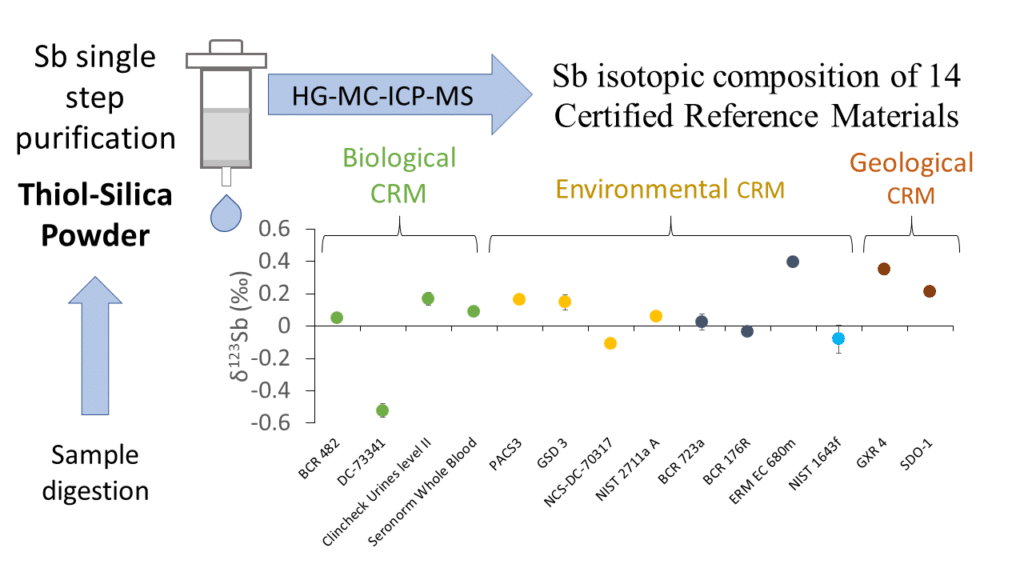
Validation with multiple reference materials shows
high recovery, low procedural blanks and no detectable
isotope fractionation caused by purification.
Summary
A simplified purification strategy for precise Sb isotope measurements
High-precision Sb isotope analysis requires effective separation of antimony from the sample matrix before measurement. Elements such as As, Sn and Te, together with high concentrations of major elements, can produce spectral interferences or matrix effects during mass-spectrometric analysis.
Conventional purification approaches may involve several chromatographic steps, increasing sample handling, analytical time and the risk of contamination or incomplete recovery.
This study develops a single-step purification procedure based on thiol-functionalized mesoporous silica. Under reducing conditions, Sb is retained selectively by the thiol groups while most other matrix elements are removed during successive acid-washing steps.
The purified Sb fraction is subsequently recovered using concentrated HCl and can be measured by hydride-generation multi-collector inductively coupled plasma mass spectrometry (HG-MC-ICP-MS).
The procedure was tested across environmental, geological and biological matrices and validated using a broad set of certified and reference materials. The results demonstrate that precise isotope measurements can be obtained without introducing detectable isotope fractionation during purification.
Main result
A single purification step is sufficient to isolate Sb for high-precision isotope analysis across complex sample matrices. The method combines low procedural blanks, efficient removal of potential interfering elements, quantitative Sb recovery and an external reproducibility of approximately 0.05‰ (2 SD), while producing no detectable isotope fractionation during purification.
Analytical results
Low blanks, efficient purification and high analytical precision
The analytical performance of the method was assessed using Sb masses representative of low-concentration environmental and geological samples together with reference materials covering a range of matrices.
Method validation
A controlled workflow from sample matrix to purified Sb
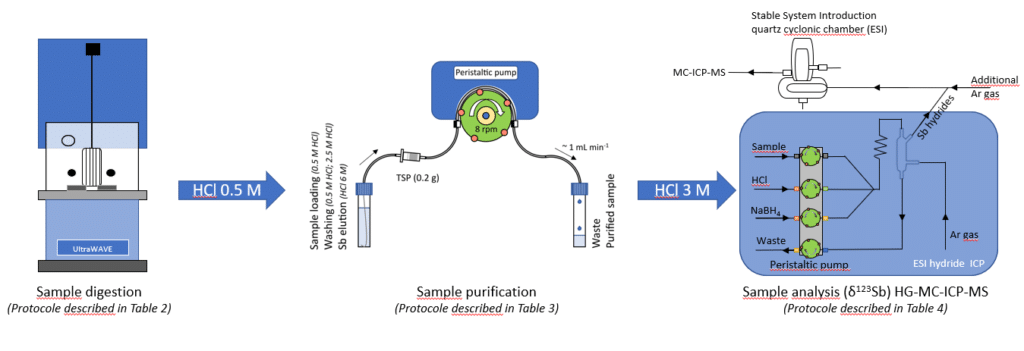
The purification workflow exploits the strong affinity of reduced Sb for thiol groups. After Sb is retained on the functionalized silica, matrix elements are removed with controlled acid washes before the purified Sb fraction is recovered for isotope analysis. Validation across reference materials confirms both quantitative recovery and the absence of measurable isotope fractionation introduced by the separation.
Analytical scope
Why purification is critical for reliable isotope fingerprinting
Isotope differences used for tracing environmental sources and processes are often small, so contamination, incomplete recovery or matrix effects during sample preparation can directly compromise interpretation. A robust purification method must therefore remove interfering elements while preserving both the amount and isotope composition of the analyte. By combining a single separation step, low blanks and high reproducibility, this procedure provides an analytical basis for comparing Sb isotope signatures across environmental waters, sediments, geological materials and biological samples.
Publication
Scientific reference
Citation
Ferrari, C., Resongles, E., Freydier, R., Casiot, C. (2021). A single-step purification method for the precise determination of the antimony isotopic composition of environmental, geological and biological samples by HG-MC-ICP-MS. Journal of Analytical Atomic Spectrometry, 36, 776–785.
DOI:
10.1039/D0JA00452A
Read the paper