
Key points
What the study shows
This study provides the first theoretical estimates
of equilibrium Sb isotope fractionation between
stibnite and several secondary antimony minerals.
Secondary Sb minerals are predicted to be
isotopically heavier than stibnite at equilibrium.
At approximately 22 °C, the calculated range of
equilibrium isotope compositions spans about
2.3‰ between stibnite and
Sb₂O₅.
Isotope fractionation is controlled by oxidation
state, the nature of the first atomic neighbours
around Sb and distortion of Sb–O coordination
environments.
Summary
Predicting the isotope fingerprints of Sb minerals
Antimony released during the weathering and oxidation of primary ore minerals can be incorporated into a range of secondary Sb-bearing phases. These mineral transformations can potentially change isotope composition even in the absence of kinetic processes.
Understanding this equilibrium isotope fractionation is therefore essential for interpreting δ123Sb signatures in ores, weathering products, mine wastes and contaminated environments.
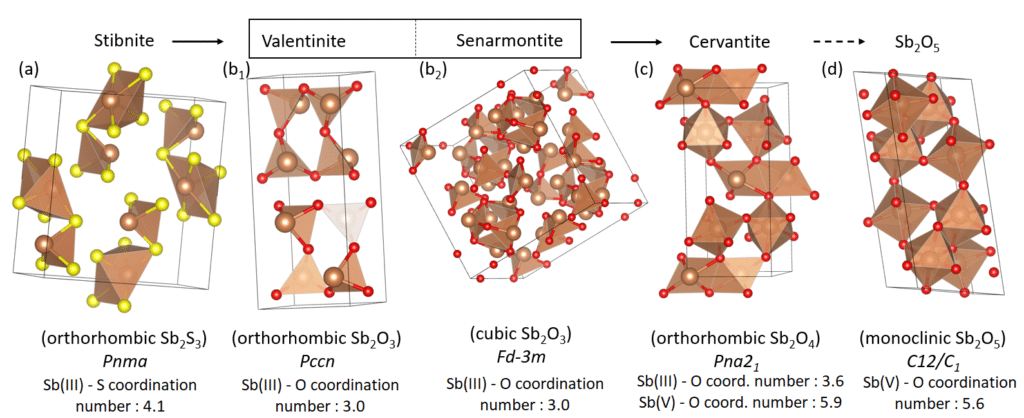
This study uses first-principles calculations to estimate equilibrium mass-dependent Sb isotope fractionation among stibnite and several secondary minerals, including valentinite, senarmontite, cervantite and a fully oxidized Sb₂O₅ structure.
The calculations show a systematic tendency for secondary oxide minerals to display higher reduced partition-function ratios than stibnite. As a result, the oxidized and oxygen-bearing mineral phases are predicted to preferentially incorporate the heavier 123Sb isotope at equilibrium.
The magnitude of this effect is controlled not simply by mineral identity, but by the local atomic environment of Sb: oxidation state, Sb–O versus Sb–S bonding, coordination and distortion of the polyhedra surrounding Sb all contribute to the predicted isotope composition.
Main result
Secondary Sb minerals are predicted to be isotopically heavier than stibnite at equilibrium. At about 22 °C, calculated lnβ values increase from approximately 0.71‰ for stibnite to 3.03‰ for Sb₂O₅, corresponding to a theoretical mineral-to-mineral range of about 2.3‰. This demonstrates that mineral transformation alone can generate substantial Sb isotope differences.
Theoretical results
A progressive enrichment in heavy Sb isotopes from sulfide to oxide minerals
The calculated reduced partition-function ratios increase systematically across the investigated minerals, revealing a strong relationship between atomic structure and equilibrium isotope composition.
Mineral comparison
Atomic structure controls equilibrium isotope fractionation
The comparison among Sb-bearing minerals shows that isotope composition is strongly related to the local bonding environment around antimony. Replacing sulfur neighbours with oxygen, increasing oxidation state and modifying the geometry of Sb–O polyhedra all affect bond stiffness and therefore the relative stability of the heavy and light Sb isotopes.
Geochemical significance
Why mineral transformations matter for Sb isotope tracing
Differences in Sb isotope composition between an ore, a weathering product and a secondary mineral do not necessarily indicate different Sb sources. Theoretical equilibrium fractionation shows that mineral transformation itself can generate per-mil-scale isotope differences as Sb moves from sulfide-bearing primary minerals into oxidized secondary phases. Accounting for mineralogy and oxidation state is therefore essential when δ123Sb values are used to reconstruct sources, weathering pathways or contaminant transport in mining-impacted environments.
Publication
Scientific reference
Citation
Ferrari, C., Méheut, M., Resongles, E., Freydier, R., Casiot, C. (2022). Equilibrium mass-dependent isotope fractionation of antimony between stibnite and Sb secondary minerals: A first-principles study. Chemical Geology, 611, 121115.
DOI:
10.1016/j.chemgeo.2022.121115
Read the paper