Element focus · Antimony

Antimony isotopes: from a trace element to a source fingerprint.

Antimony can carry information that concentration alone cannot provide. Its stable isotope composition can help compare sources, follow environmental transfers and test the provenance of materials in mining, environmental, archaeological and industrial systems.

51 Sb antimony 121.760
¹²¹Sb 57.21%
¹²³Sb 42.79%
01 · Context

Why antimony?

Antimony is considered a critical and strategic metal, its use is omnipresent in industry: paints, batteries, munitions, brake pads, flame retardants... Its isotopes therefore provide information on both industrial and environmental traceability.

Where is Sb found?

Antimony is a metal rarely found in isolation. It is most often found in areas with high mineralization, particularly where sulfur concentrations are significant. It also frequently occurs alongside arsenic, another toxic metalloid. Therefore, it is not uncommon to find antimony in mining or industrial settings, even when the mining operation does not directly extract the antimony.

Multiple anthropogenic sources

Because of its omnipresence in our industrial applications, antimony can end up in the environment in many ways: via mining and metallurgical industries, road dust, incineration ash, military training grounds... Because of its mobility (especially in its reduced form), it is found in water, soil and sediments.

Why isotopes are useful

These isotopic ratios can therefore inform us both about the origin of the material and about the processes that occurred during its transport. For example, in an environmental study, understanding the processes that remobilize antimony contaminants is essential for directly addressing its transfer vectors and reducing the risks and costs associated with remediation.

02 · Analytical

How we analyse Sb isotopes.

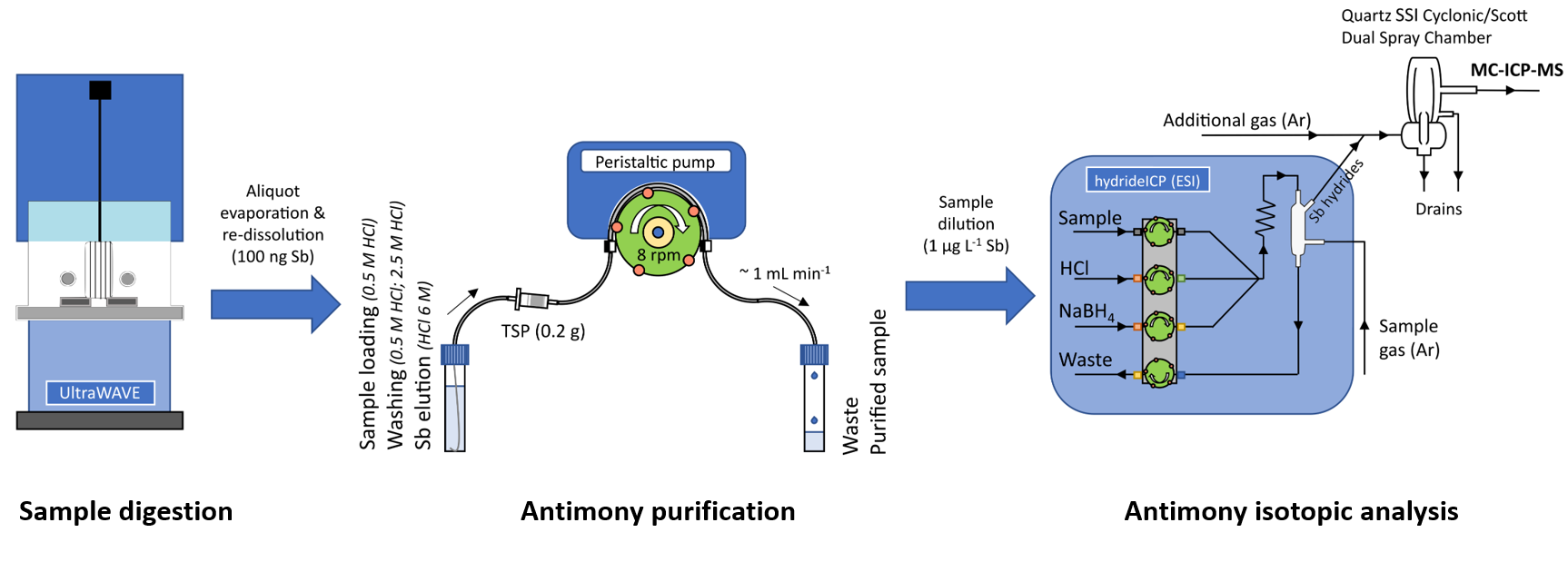
The analytical challenge is not only to measure Sb, but to isolate very small amounts of it from complex matrices without modifying its isotope composition. The workflow combines selective purification with hydride-generation multi-collector ICP-MS.

1

Sample preparation

Solid samples are digested and water samples are conditioned so that Sb can be isolated from the surrounding matrix.

2

Single-step Sb purification

Antimony is selectively retained using thiol-functionalized mesoporous silica powder (TSP), allowing major matrix elements and potential interferents to be removed.

3

Hydride generation

Purified Sb is converted into volatile hydrides, strongly increasing transport efficiency and sensitivity for low-concentration samples.

4

HG-MC-ICP-MS

The ¹²³Sb/¹²¹Sb ratio is measured by hydride-generation multi-collector ICP-MS and expressed as δ¹²³Sb relative to an isotope reference solution.

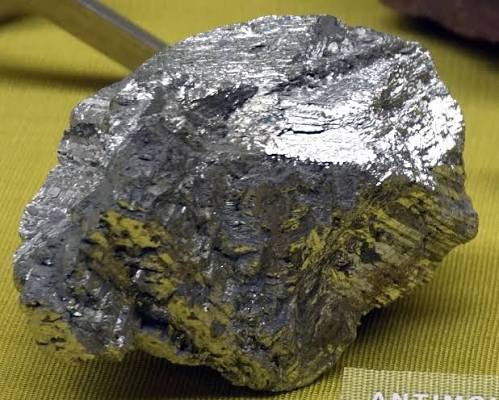
Antimony mineral specimen
Antimony isotope analytical protocol
40–100 ng

Sb required

Only a small total amount of Sb is required for the purification and isotope measurement workflow.

<1 ng

Procedural blank

Low blank levels make the method suitable for samples containing relatively small quantities of Sb.

98.7%

Average interferent removal

Efficient removal of elements including As, Cd, Co, Cr, Cu, Fe, Ni, Pb, Se and Sn.

100 ± 7%

Sb recovery

High recovery after purification, with no detectable isotope fractionation introduced by the procedure.

0.008

µg/L quantification limit

Sb quantification limit: 0.008 ± 0.001 µg/L using HG-ICP-MS.

0.05‰

External reproducibility

External reproducibility for δ¹²³Sb, reported as 2 standard deviations.

1 µg/L

Isotope measurement solution

Purified Sb isotope solutions were measured by HG-MC-ICP-MS at approximately 1 µg/L Sb.

0.026 → 850

Validated matrix range

The method was validated across CRMs ranging from 0.026 µg/mL Sb in blood to 850 µg/g in fly ash.

Method basis

Analytical values are based on Ferrari et al. (2021), validated on 14 environmental, geological, biological and anthropogenic certified reference materials. The exact preparation route is adapted to the matrix and available Sb mass.   View the publication →

03 · Interpretation

What can Sb isotopes tell us?

The value of Sb isotopes lies in comparison. A sample becomes informative when its isotope composition is compared with potential sources, reference materials, spatial trends or process-related changes.

Distinguish contamination sources

If potential sources have different δ¹²³Sb signatures, isotope measurements can help determine whether Sb in a soil, water or sediment is compatible with mining, metallurgical, traffic-related or other anthropogenic inputs.

Example: separating several candidate source contributions at a contaminated site.

Quantify mixing and catchment contributions

Spatial variations in Sb isotope composition can help identify which tributary, source area or material contributes to the Sb load measured downstream.

Example: surface waters impacted by historic Sb mining showed δ¹²³Sb values from approximately −0.06 to +0.83‰, allowing contributions from two sub-watersheds to be evaluated.

Test material provenance

Sb isotope signatures can be compared between raw materials, ores and manufactured products to investigate whether they are compatible with the same geological or industrial origin.

Example: Sb isotopes have been investigated for the provenance of antimony ores used in ancient glass and Bronze Age artefacts.

Understand environmental processes

Sb isotope ratios may also change during transport and reaction. When combined with concentration, mineralogy and water chemistry, this can provide information on how Sb is mobilised, retained or transformed.

Important: process-related fractionation must be considered when using Sb isotopes for source attribution.
An isotope ratio is evidence, not a barcode.

The strongest interpretation combines δ¹²³Sb with Sb concentration, geochemistry, candidate source signatures and knowledge of the processes acting on the system.

Discuss an Sb project